

American economist and Levy Economics Institute researcher Michael Hudson has partnered with the Observatory to release his decades-long project: The Creation of Order.
The Creation of Order explores the archaic “kosmos-building” that is the basis of today’s societal structure and economic practices. Starting with the Ice Age, Hudson takes readers on a tour of society’s earliest administrative structures, from time-keeping to counting systems to weights and measures and more. This deep-dive into human nature and order can provide insight into our present and potentially our future.
Hudson’s The Creation of Order is the pioneer Mainframe research project published using the Observatory’s own Collaborative Research tool.
About Collaborative Research
The Observatory’s project, Collaborative Research, is a new open-ended publishing platform for writers, researchers, and curious minds. Unlike traditional book publishing, there’s no limit on the amount of supporting data, authors can flesh out sections without restrictions, and updates can be added at any time.
With Collaborative Research, authors share their large scholarly projects, known as Mainframes, on the platform and collaborate with experts on research and editorial direction. Meanwhile audiences can view the developments and provide funding if they so wish.
To learn more, contact the Collaborative Research team.
EXCERPT
The Modern Context for The Creation of Order
Taking an intellectual trip back into archaic times invariably turns into an exercise in mind expansion. Instead of asking what kind of society might result from new technological breakthroughs, one asks what kinds of societies could have produced the artifacts, records, and myths that survive. How different were the organizing principles at work and the ideas of social order that underlay the earliest urbanization and such practices as interest-bearing debt? And to what extent were these developments built into the structure of modern civilization?
The evolutionary twists and turns of the alphabet, urbanization, and land tenure point to perhaps the most striking discovery in an excursion into the archaic past: As on returning from any long trip to a foreign land, we see our own society from a new perspective. Many symbols that seemed merely decorative turn out to have a cosmological significance going back to the origins of civilization. The Bible itself may appear in a new light after reviewing the Bronze Age past, particularly its periodic debt cancellations and notions of social liberty and equity. Some archaeologists try to make popular points by leaning with the prevailing political winds and lauding the benefits of individualism. The fact that early Mesopotamia and Egypt yielded to more individualistic (and aristocratic) Iron Age successors is taken to mean that they were not “efficient”; otherwise they would not have been conquered. Does this really demonstrate the benefits of economic individualism? Or did lower-level armies conquer the more sophisticated societies of Mesopotamia, Egypt, and the eastern Mediterranean?
The Creation of Order is now available on the Observatory. Read more here.
ABOUT
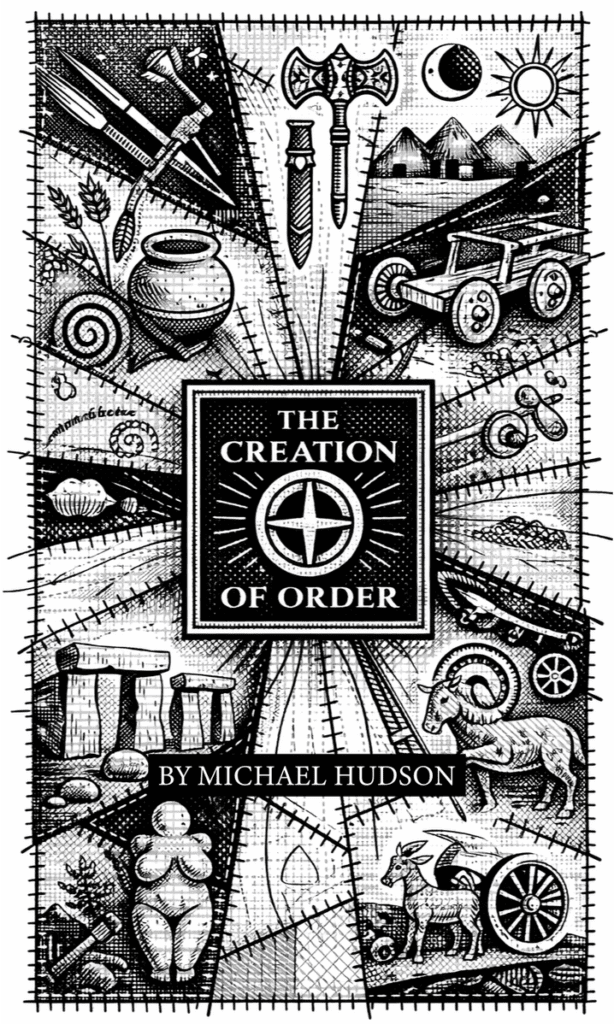
Title: The Creation of Order
Subtitle: Archaic Organization of Time, Measurement and Laws, Music, Tribes, and Cities
Author: Michael Hudson
Source: Human Bridges Project
Author Bio: Michael Hudson is an American economist, a professor of economics at the University of Missouri–Kansas City, and a researcher at the Levy Economics Institute at Bard College. He is a former Wall Street analyst, political consultant, commentator, and journalist. He is a contributor to the Hudson Report, a weekly economic and financial news podcast produced by Left Out. Hudson graduated from the University of Chicago (BA, 1959) and New York University (MA, 1965, PhD, 1968) and worked as a balance of payments economist in Chase Manhattan Bank (1964–68). He was assistant professor of economics at the New School for Social Research (1969–72) and worked for various governmental and non-governmental organizations as an economic consultant (1980s–1990s).